Six gemstone rings worth adding to your collection
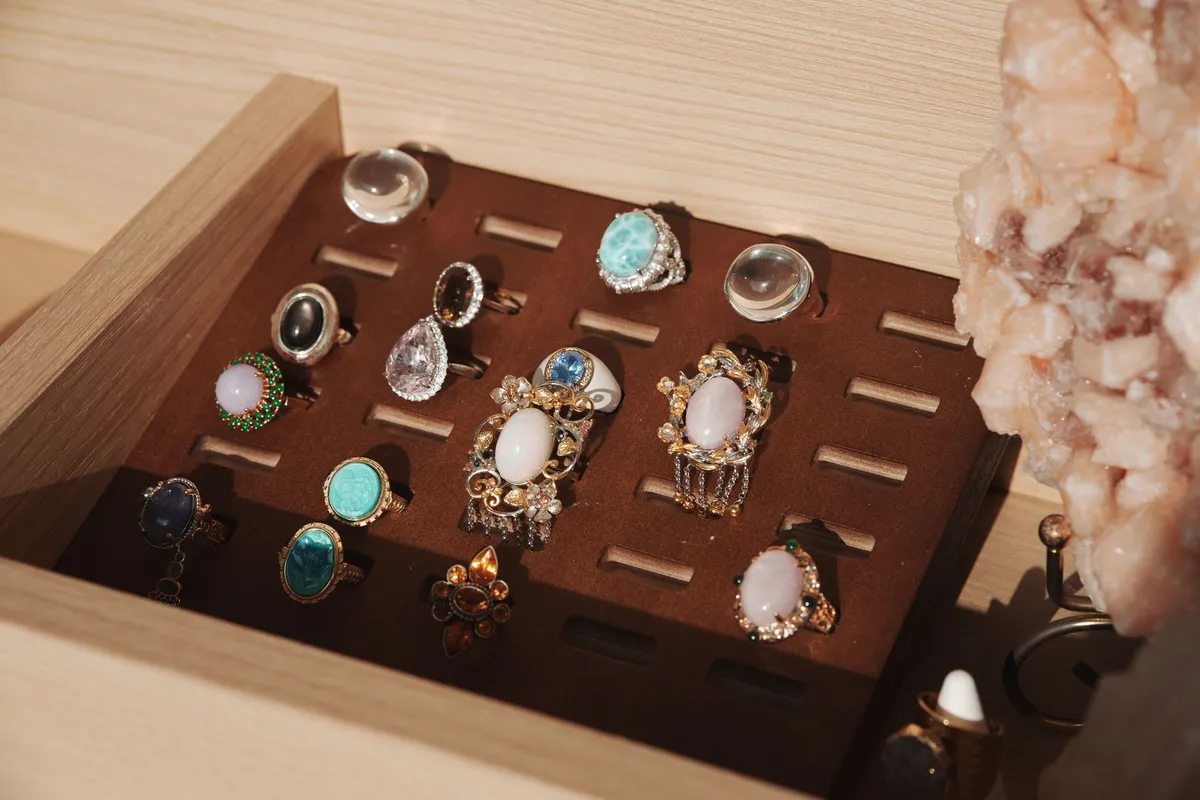
A gemstone ring adds colour where a plain band cannot. But gemstones are not equal: some will survive decades of daily wear, others will be scratched in a few months on the hand that types, cooks and carries bags. Choosing well means pairing a stone you love with a setting and a use that suit its nature.
Hardness: the first thing to know
Gem hardness is measured on the Mohs scale, from 1 (talc) to 10 (diamond). Everyday dust contains quartz, at 7, so a stone softer than 7 will slowly lose its polish if worn often.
| Stone | Mohs hardness | Daily wear on a ring |
|---|---|---|
| Diamond | 10 | Excellent |
| Sapphire, ruby (corundum) | 9 | Excellent |
| Topaz | 8 | Very good (but can split with a sharp knock) |
| Quartz (amethyst, citrine, smoky quartz) | 7 | Good |
| Jadeite | about 6.5–7 | Good, very tough |
| Opal | about 5.5–6.5 | Careful wear |
| Turquoise | about 5–6 | Careful wear |
Hardness is not the only factor: toughness, the resistance to chipping and breaking, matters too. Jade is not especially hard but is extremely tough; topaz is hard but can cleave if struck at the wrong angle.
1. Smoky quartz cocktail ring
Smoky quartz ranges from pale grey-brown to a deep coffee colour. It is often cut in large stones for cocktail rings, where its warm, transparent brown looks rich in yellow or rose gold and modern in silver. At hardness 7 it tolerates regular wear, and large clean stones are affordable compared with most coloured gems.
2. Jade solitaire
“Jade” covers two different minerals, jadeite and nephrite, both prized for their toughness. A polished jade cabochon in a simple silver or gold bezel is understated and very durable. The finest jadeite, an intense translucent green, is among the most expensive gems; most jade jewelry is far more accessible. Ask whether the jade has been treated: dyed or polymer-impregnated jade is common and worth much less.
3. Ruby in a bohemian setting
Ruby is red corundum, at hardness 9, one of the most durable coloured stones. Small rubies set in engraved or granulated gold, sometimes alongside other colours, give a relaxed “boho” style. Most rubies on the market are heat-treated, which is standard and stable; some are filled with glass, which is a much more fragile treatment. A reputable seller will tell you which.
4. Opal
Opal shows a play of colour that no other stone matches. It is also delicate: softer than quartz, sensitive to knocks and sudden temperature changes, and in some types to dehydration. Opal rings are best worn with care, in a protective bezel setting rather than claws, and taken off for sport, cleaning and gardening. Doublets and triplets, thin slices of opal backed or capped with other materials, must never be soaked.
5. Blue topaz
Most blue topaz on the market starts as colourless topaz and is treated to obtain its sky, Swiss or London blue. The colour is stable, the stone is hard and the price is moderate, which makes blue topaz a popular choice for larger rings. Protect it from sharp knocks, which can split it along its cleavage.
6. Blue sapphire
Sapphire offers the durability of a diamond, almost, with colour. Blue is the classic, but sapphires also come in pink, yellow, green and white. A sapphire solitaire or a sapphire surrounded by small diamonds is a traditional alternative engagement ring. Lab-grown sapphires are chemically the same as natural ones and much cheaper; they should be disclosed as such.
Settings that protect
- Bezel: a rim of metal around the stone. The most protective, ideal for soft or brittle stones and active hands.
- Prongs (claws): let more light in, but leave the edges exposed. Four or six prongs are standard; check them regularly.
- Low profile: stones set close to the finger catch less on clothes and knocks.
Caring for gemstone rings
- Clean hard stones (sapphire, ruby, topaz, quartz) in warm water with mild soap and a soft brush.
- Clean opal, turquoise and treated stones with a damp cloth only.
- Avoid ultrasonic cleaners unless you know the stone and its treatment tolerate them.
- Store rings separately: a sapphire will scratch an opal, and a diamond will scratch everything.
- Have prongs checked by a jeweller once a year if you wear the ring daily.
A gemstone ring is as durable as its weakest point. Choose the stone for its colour, the setting for its protection, and keep the softer stones for days when your hands are at rest.