Why marcasite is unstable, and what 'marcasite' jewelry really is
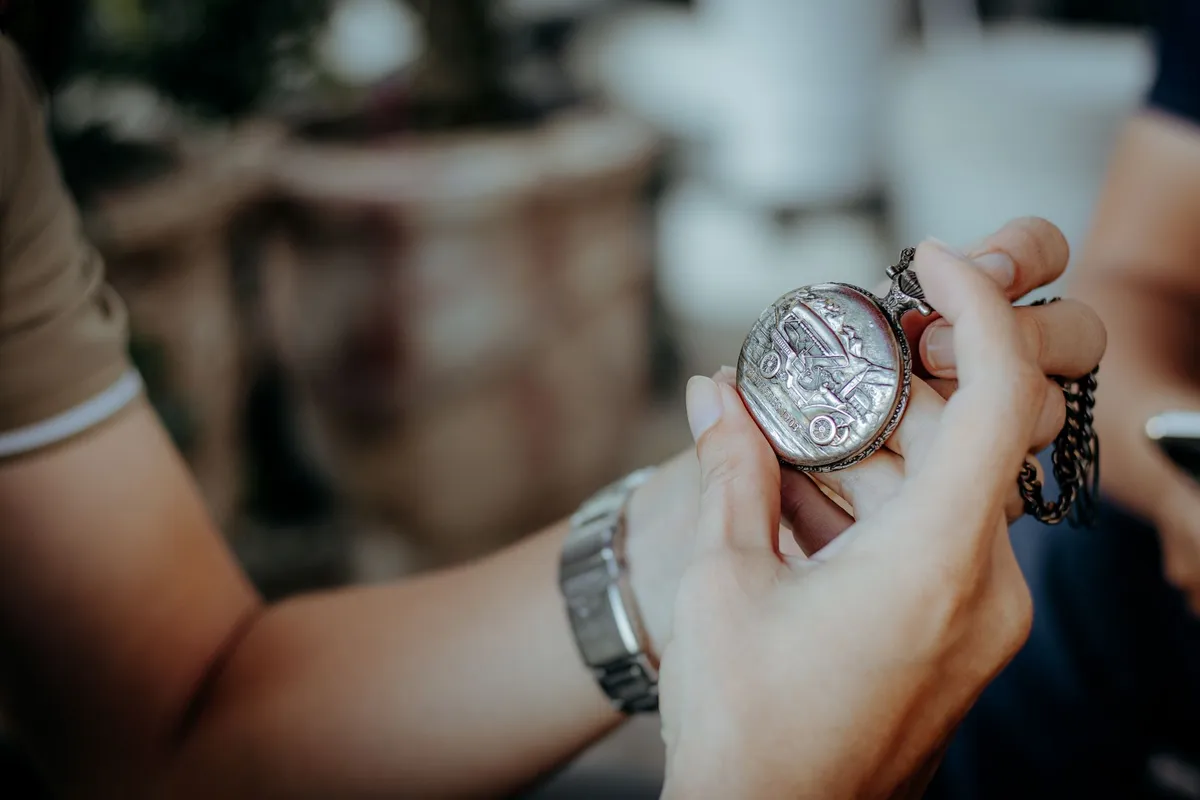
Marcasite jewelry, those small faceted grey-gold stones set in sterling silver, has been worn since the 18th century and is still made today. Yet the mineral called marcasite is one of the least stable in a collector’s cabinet: specimens can crumble to powder in a few years. The explanation of that paradox is a nice lesson in mineralogy, and a useful one for anyone who owns marcasite jewelry.
Two minerals, one formula
Marcasite and pyrite are both iron disulphide, FeS₂. What separates them is how the atoms are arranged:
| Pyrite | Marcasite | |
|---|---|---|
| Formula | FeS₂ | FeS₂ |
| Crystal system | Cubic | Orthorhombic |
| Typical habit | Cubes, octahedra, pyritohedra | Blades, “cockscomb” and spear-shaped aggregates |
| Colour (fresh) | Brassy yellow | Paler, whitish to pale brass |
| Stability | Relatively stable | Metastable, decays readily |
Minerals with the same composition but different structures are called polymorphs. Diamond and graphite are the best-known example. Among the iron disulphides, pyrite is the stable form under surface conditions; marcasite forms under particular conditions, typically at low temperature and in more acidic environments, and keeps its orthorhombic structure only because the transformation to pyrite is very slow.
Why marcasite falls apart
Being metastable is not the main problem. The real issue is that marcasite reacts readily with oxygen and water vapour. In humid air, the surface oxidises and forms iron sulphates, which take up more volume than the original mineral, together with sulphuric acid. Cracks open, a white or yellowish powder appears, and the specimen eventually disintegrates. The acid can also attack labels, boxes and neighbouring specimens.
Mineral collectors call this “pyrite decay”, although marcasite is usually more vulnerable than pyrite. Fine-grained material is particularly at risk, because it offers more surface to the air. Museums keep susceptible specimens at low humidity for that reason.
So what is marcasite jewelry made of?
Almost always pyrite. The jewelry trade adopted the name “marcasite” long ago, and it stuck, but jewellers use pyrite precisely because it is the more stable of the two. The small stones are cut flat on the back with a faceted, often rose-cut top, then set close together so their metallic sparkle reads as a continuous surface.
Marcasite jewelry became fashionable in the 18th century as an affordable alternative to diamonds and to cut-steel ornaments. It had new waves of popularity in the Victorian era and in the Art Deco period, when its geometric sparkle suited the style perfectly. Most pieces are set in sterling silver, sometimes combined with onyx, enamel or coloured stones.
Setting: claws, beads and glue
How the stones are held tells you a lot about a piece:
- Bead or pavé settings: tiny grains of silver raised from the metal hold each stone. This is the traditional method and the most durable.
- Glued stones: cheaper pieces simply cement the stones into recesses. They fall out more easily, especially when wet.
Turn a piece over and look closely with a loupe: small metal beads around each stone are a sign of a properly set piece.
Caring for marcasite jewelry
Pyrite is far more stable than marcasite, but it is still a sulphide, and the settings are delicate. A few rules:
- Keep it dry. Do not wear marcasite jewelry in the shower, the pool or the sea, and dry it if it gets wet.
- No soaking, no ultrasonic cleaner, no steam. Water and vibration loosen glued stones and can affect the pyrite.
- No silver dips. Liquid silver cleaners attack pyrite and dull it. Clean the silver with a dry polishing cloth, carefully around the stones.
- Brush, don’t scrub. A soft, dry brush removes dust from between the stones.
- Store it separately, in a dry place, away from harder stones that could scratch the pyrite and from humidity.
If a stone falls out, keep it and take the piece to a jeweller: replacement marcasite stones exist in standard sizes, and resetting is usually a simple job.
Marcasite in collections
If you collect minerals rather than jewelry, true marcasite needs attention: store specimens in a dry, stable environment, check them regularly, and isolate any piece that shows white powder or a sulphurous smell, so the decay does not spread to neighbouring specimens.
Marcasite and pyrite show how much a crystal structure matters. The same atoms, arranged differently, give a mineral that crumbles in a damp drawer and one that has sparkled on silver brooches for three centuries.