Gold chain necklaces: links, carats and lengths explained
A gold chain is the most versatile piece of jewelry there is. It can be worn alone, with a pendant, layered with other chains, every day or for an evening. But behind the word “chain” there are dozens of link styles, several gold standards and a range of lengths that change the look entirely. Here is how to find your way.
The main link styles
| Style | Description | Strength | Best for |
|---|---|---|---|
| Cable | Simple oval or round links | Good | Pendants, everyday wear |
| Curb | Flattened, twisted links that lie flat | Very good | Worn alone, men’s chains |
| Figaro | Short links alternating with a long one | Good | Worn alone or with a medal |
| Rope | Links twisted into a spiral | Good | Shine, worn alone |
| Box | Small square links | Good | Sleek pendants |
| Wheat (spiga) | Interlocking links forming a braid | Very good | Pendants, a textured look |
| Paperclip | Long open rectangular links | Good | Fashion, layering |
| Snake | Smooth, flexible tube of plates | Fragile if kinked | A liquid look, light pendants |
| Herringbone | Flat, overlapping slanted links | Fragile if kinked | Worn alone, lies flat |
Snake and herringbone chains are beautiful but cannot be repaired invisibly once kinked. Keep them for occasions and store them flat.
Choosing the carat
Gold purity is expressed in carats out of 24:
- 9 ct (37.5 % gold): the hardest and most affordable, common in the UK. Paler colour.
- 14 ct (58.5 %): a good balance, common in the US and much of Europe.
- 18 ct (75 %): the standard for fine jewelry in France and Italy, richer in colour, softer.
- 22 ct (91.6 %): deep yellow, soft, traditional in some cultures for wedding and heritage jewelry.
For a fine chain worn every day, a lower carat is harder and resists stretching and knots better. For a heavier chain, 18 ct gives a richer colour without being too soft.
Solid, hollow or plated?
- Solid gold: the links are full metal. Durable, repairable, holds its value in gold.
- Hollow gold: the links are tubes. They look bigger for less gold and less money, but dent and break easily and are hard to repair.
- Gold filled: a thick layer of gold bonded to a base metal. Much more durable than plating, but not solid gold.
- Gold plated: a very thin layer of gold over base metal or silver. Affordable, but wears with time.
Ask for the weight in grams: it tells you how much gold you are buying and is the fairest basis for comparing prices.
Choosing the length
| Length | Where it falls | Typical use |
|---|---|---|
| 40 cm | Base of the neck | Fine chain with a small pendant |
| 45 cm | On the collarbone | The most common women’s length |
| 50 cm | Below the collarbone | Pendants, layering |
| 55–60 cm | Upper chest | Common men’s lengths |
| 70 cm + | Mid-chest | Long chains, over clothing |
The same chain falls differently depending on the neck and the build of the person wearing it. If you can, measure a chain they already wear.
Thickness and pendants
A pendant needs a chain that can carry it, both physically and visually. A heavy pendant on a very fine chain will twist the chain and may break it; a tiny pendant on a thick chain disappears. Check also that the pendant’s bail is wide enough for the chain, and that the clasp can pass through it.
Layering chains
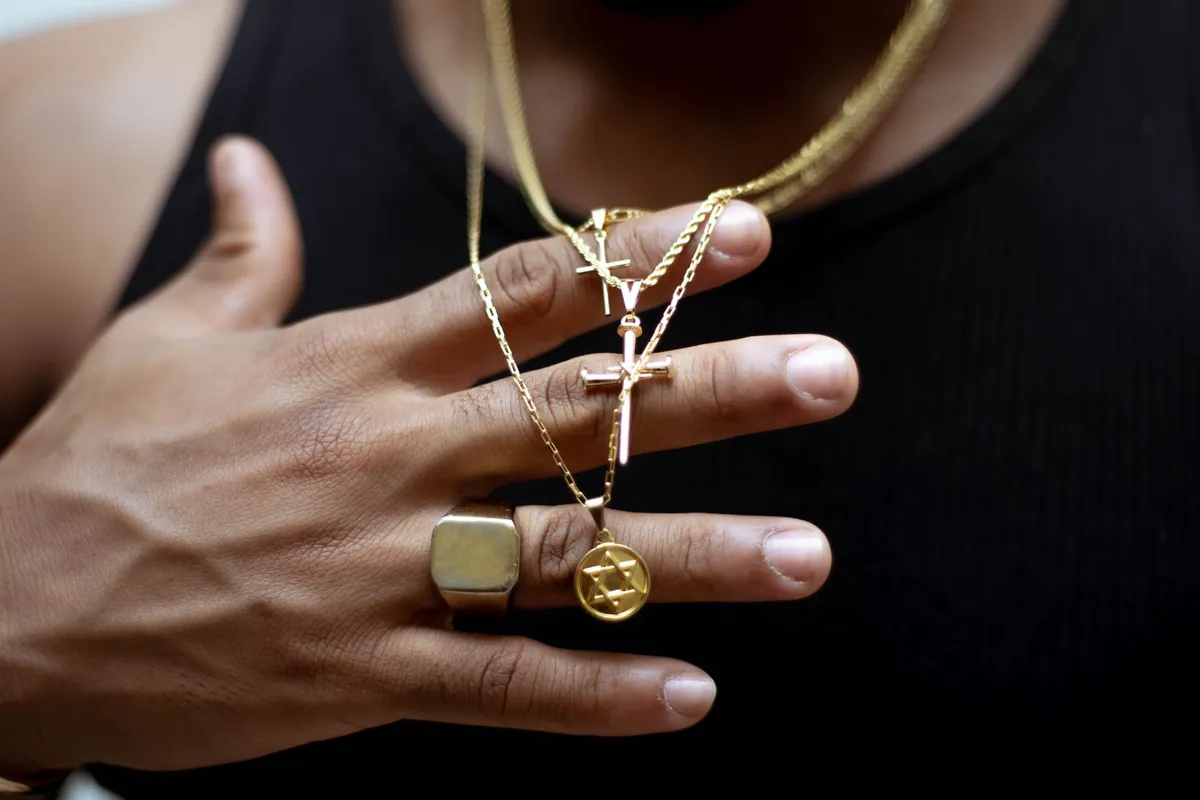
Layering several chains is easy if you follow two rules: vary the lengths by at least 5 cm so the chains do not tangle, and vary the textures, such as a fine cable, a paperclip and a curb, so each one reads clearly. Mixing yellow and white gold is fine as long as the mix is repeated.
Clasps
Lobster clasps are strong and common. Spring rings are found on finer chains and are more delicate. Box clasps with safety catches suit heavy chains. Magnetic clasps are easy to use but less secure for valuable pieces.
Caring for gold chains
- Remove chains for sleep, sport, swimming and cleaning: chlorine and household products can weaken gold alloys over time.
- Clean in warm water with a drop of mild washing-up liquid, using a soft brush, then rinse and dry.
- Store chains separately, fastened, to avoid knots.
- Untangle a knot with two pins on a flat surface, never by pulling.
- Have the clasp and jump rings checked occasionally.
A good gold chain is a long-term companion. Choose the link for the look, the carat for the way you live, and the length for the person who will wear it.